Pick up stitches
How many stitches do I pick up?
Picking up for a button band or neckband? Get how many stitches to pick up, and which rows to pick them up in, so the band lies flat.
Worked example
A side edge of 60 rows, at a gauge of 22 stitches and 30 rows to 10 cm: pick up 44 stitches — about 3 for every 4 rows, skipping 1 more row along the edge.
How it works
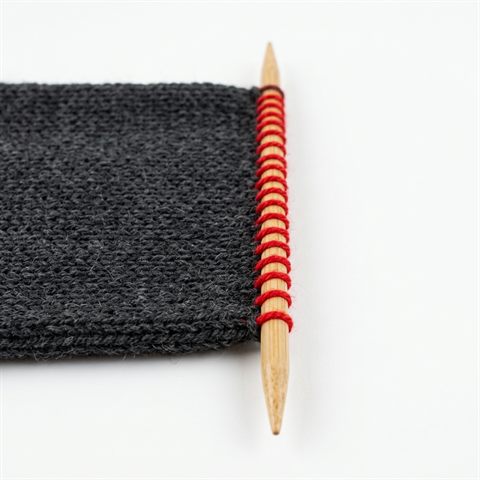
Along the side of your knitting you pick up into row ends, and there are more rows than stitches in any length of fabric. Stitches per row is your stitch gauge divided by your row gauge — so for 22 stitches and 30 rows, you pick up about 3 stitches for every 4 rows. The strip under the answer shows exactly which rows to pick up in; tap it to keep your place.
No row gauge? The usual ratios are 3 stitches for every 4 rows of stockinette and 1 for every 2 rows of garter stitch (one in each ridge). Your own row gauge gives a count that fits your knitting exactly.
Along a measured length the count comes from your stitch gauge alone: length × stitches per 10 cm (or per 4 in, or per inch). Along a cast-on or bind-off edge, pick up one in each stitch.
For a neckline, enter the stitches across the back and front neck and the rows down each side of the front neck. Stitches are picked up one for one and rows by your gauge, and the total is shared out so both sides match. A V-neck can have one stitch picked up at its point and marked; the band either side of it is rounded like a flat band, then the point stitch is added.
Use the row gauge of the fabric you're picking up from. For the stitches, your body's stitch gauge works for most bands; if you swatched the band itself (rib on smaller needles usually has more stitches to 10 cm), enter its gauge too and the count follows the band.
Pick the band's rib and whether it's knitted flat or in the round, and the count is rounded to fit: 1×1 rib knitted flat needs an odd number, 2×2 rib a multiple of 4 plus 2; in the round, just a multiple of 2 or 4.
Got a number from your pattern? Enter it with the pattern's edge length and yours, and it's scaled to your edge, so a longer or shorter front still gets a band that fits.
Long edges get stitch markers, so you count part by part. Buttonholes are spaced evenly, with the same few stitches before the first and after the last.
Sources: Kelbourne Woolens, “Perfectly Picked Up Stitches”; Knitty, “Techniques with Theresa” (Winter 2004); Tin Can Knits, “Button Bands: How to Pick Up and Knit a Button Band”