Increase & decrease evenly
How do I spread 12 increases evenly?
Patterns often say “increase 12 stitches evenly across” and leave the arithmetic to you. Enter the stitches you have and how many to add or remove, or the count to end with, and this works out exactly where each one goes, in knitting or crochet.
Worked example
100 stitches in the round, decrease 12 evenly: (K7, K2tog) ×4, (K6, K2tog) ×8. 100 stitches don't share out exactly, so the first 4 gaps are one stitch longer. You end with 88 stitches.
How it works
The stitches are shared out as evenly as whole stitches allow. When they don't divide exactly, some gaps are one stitch longer. If the gaps are long, the longer ones are grouped together so the instruction stays easy to follow; a one-stitch difference doesn't show in the fabric. If the gaps are short, the longer ones are spread through the row instead, so the shaping doesn't bunch up.
Worked flat, half a gap goes at each end of the row so the edge stitches stay plain for seaming or picking up, and you can keep more edge stitches plain if you like. In the round there are no edges, so every gap is a full one.
Pick the increase you use. An M1 is any single increase worked between two stitches (M1L, M1R, a lifted increase), and a yarn over goes in the same place. A kfb is worked into a stitch, so it uses one up and each gap is a stitch shorter. K2tog and SSK give the same count; pick the one your pattern uses.
On a wrong-side row the instruction is purled, with the purl version of each increase and decrease. In crochet (US terms), an increase is 2 stitches worked into one, and a decrease is 2 stitches worked together.
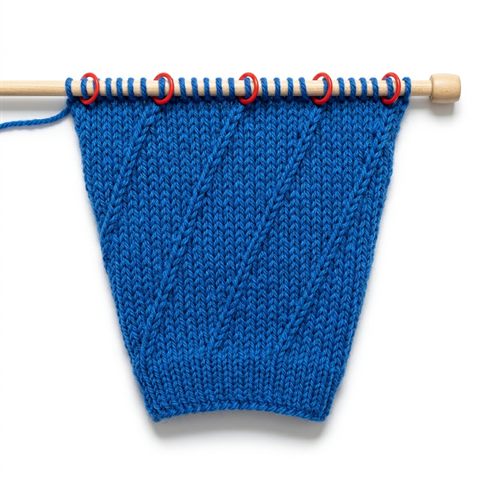
Spread over several rows, each row's changes are moved along a little, so they don't stack up into a line.