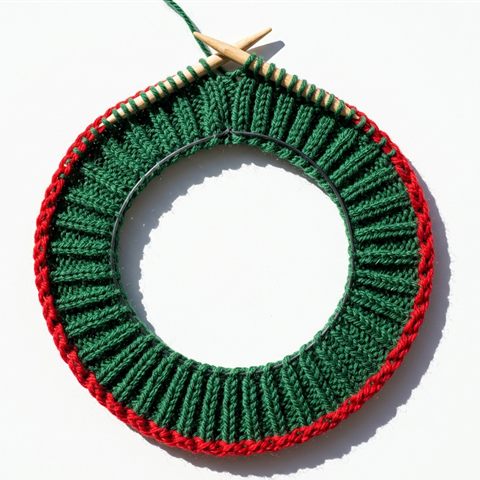
Cast-on from gauge
How many stitches do I cast on?
Designing your own piece, or knitting a pattern at a different gauge? Start from the width, the pattern's cast-on, or your body measurement plus ease. Add your stitch gauge and get the cast-on count.
Worked example
A 50 cm wide piece at 22 stitches to 10 cm: cast on 110 stitches (112 for 2×2 rib in the round).
How it works
Stitches = width × stitches per centimeter (your gauge divided by the width it's measured over), rounded to a whole stitch.
Give your gauge the way you measured it: per 10 cm, per 4 in, per inch, or over any width you counted on your swatch.
Starting from a pattern's cast-on? Its stitches divided by its gauge give the width it makes, and that width times your gauge gives your count. Use the pattern's whole cast-on, edge stitches included, so none are added again.
Starting from your body? Measure around it and pick what you're knitting. Hats and socks are knit about 10% smaller than the head or foot, so they stay put; mittens about 5% bigger, so your fingers can move. A sweater is bigger than the chest: from 2.5 cm (1 in) for a close fit to 20 cm (8 in) oversized, the same ease as the raglan planner. Worked flat, its front and back are each half as wide.
If the edge is ribbed or patterned, set the stitch multiple (for example a multiple of 4 plus 2 for 2×2 rib worked flat) and the count is rounded to the nearest number that fits. An exact tie rounds up: a little wider is easier to wear than a little tight.
The answer also gives the count on the other side, for a snugger or roomier fit. The stitch pattern buttons fill in the usual numbers: 1×1 rib and seed stitch are a multiple of 2 (plus 1 worked flat), 2×2 rib a multiple of 4 (plus 2 flat), 3×3 rib a multiple of 6 (plus 3 flat). In the round, none of them needs the extra stitches.
Worked flat and sewn up later? Add one or two edge stitches each side: they go into the seam, so they're added after the rounding.
Measure your gauge on a washed and blocked swatch, in the stitch the piece uses.
Sources: Tin Can Knits, “What is ease?”; Knotions, “Understanding ease”