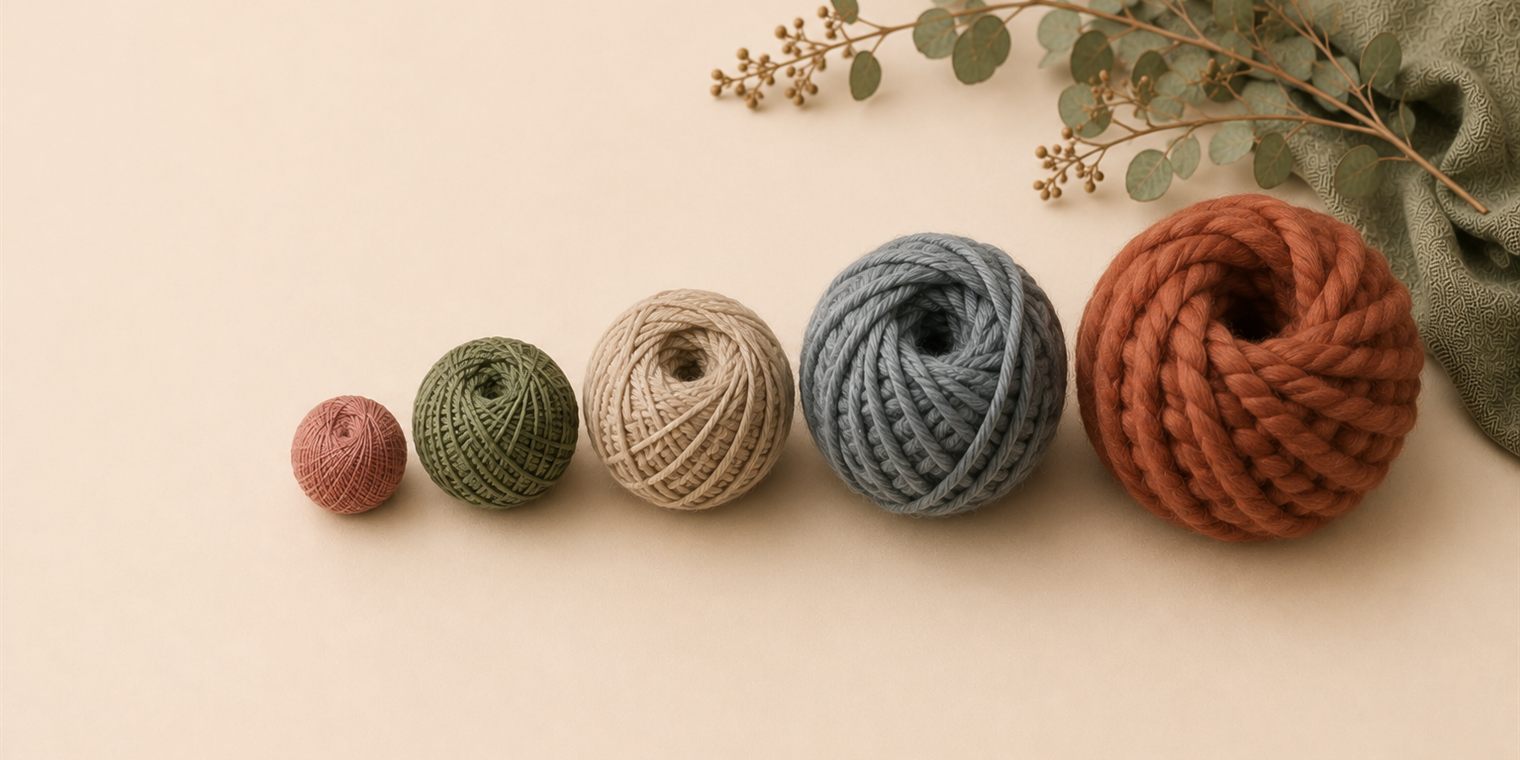
What Is Yarn Weight, Really? From Lace to Super Bulky
The seven weight classes explained by what they feel like to knit, how long projects take, and what each one is secretly best at.
Techniques · Purl Wise Editorial · May 2026 · 9 min read
"Weight" is knitting's most confusing word — it has nothing to do with grams. A yarn's weight is its thickness, and the seven common classes each have a personality worth knowing before you commit a month of evenings to one.
Lace is sewing-thread territory: enormous yardage, glacial progress, and the magic trick of blocking — a crumpled cobweb stretches into a cathedral window. It forgives nothing and rewards patience extravagantly.
Fingering is the sock-and-shawl workhorse. Around 400 yards per 100 grams, fine enough for fabric with drape, sturdy enough for daily-wear socks. It's also where indie dyers concentrate their most beautiful work, which is why every stash quietly accumulates it.
Sport and DK occupy the sweet middle. DK — "double knitting," a British term that outlived its origin — makes lightweight garments you can actually wear indoors, at a pace that doesn't test your resolve. If fingering sweaters feel endless and worsted ones feel like armor, DK is your answer.
Worsted and aran are the classic learning weights: big enough stitches to read your knitting and catch mistakes, quick enough that a hat happens in an evening or two. Most iconic North American patterns of the last fifty years assume one of these.
Bulky and super bulky are instant gratification — a cowl in an hour, a blanket in a weekend. The fabric is warm and dramatic, with two caveats: garments get heavy fast, and yardage per skein is tiny, so blankets cost more than their simplicity suggests.
Two practical notes. First, the boundaries blur: one mill's heavy DK is another's light worsted, so trust the gauge number over the name. Second, weight classes are why stash matching works at all — a pattern written for worsted will accept nearly any worsted, which means the right question isn't "do I own this exact yarn?" but "do I own enough of this weight?" That's precisely the question our stash matcher answers.
One mill's heavy DK is another's light worsted — trust the gauge number over the name.
Once weights click, patterns sort themselves into "possible now" and "needs shopping." A few favorites across the spectrum: