A Beginner's Guide to Reading a Yarn Label
Weight class, gauge square, care icons, dye lots — everything the ball band is trying to tell you, decoded in plain language.
Techniques · Purl Wise Editorial · Jun 2026 · 7 min read
A yarn label is a densely packed little document, and once you can read it fluently, yarn shops become much less mysterious. Here's the tour, top to bottom.
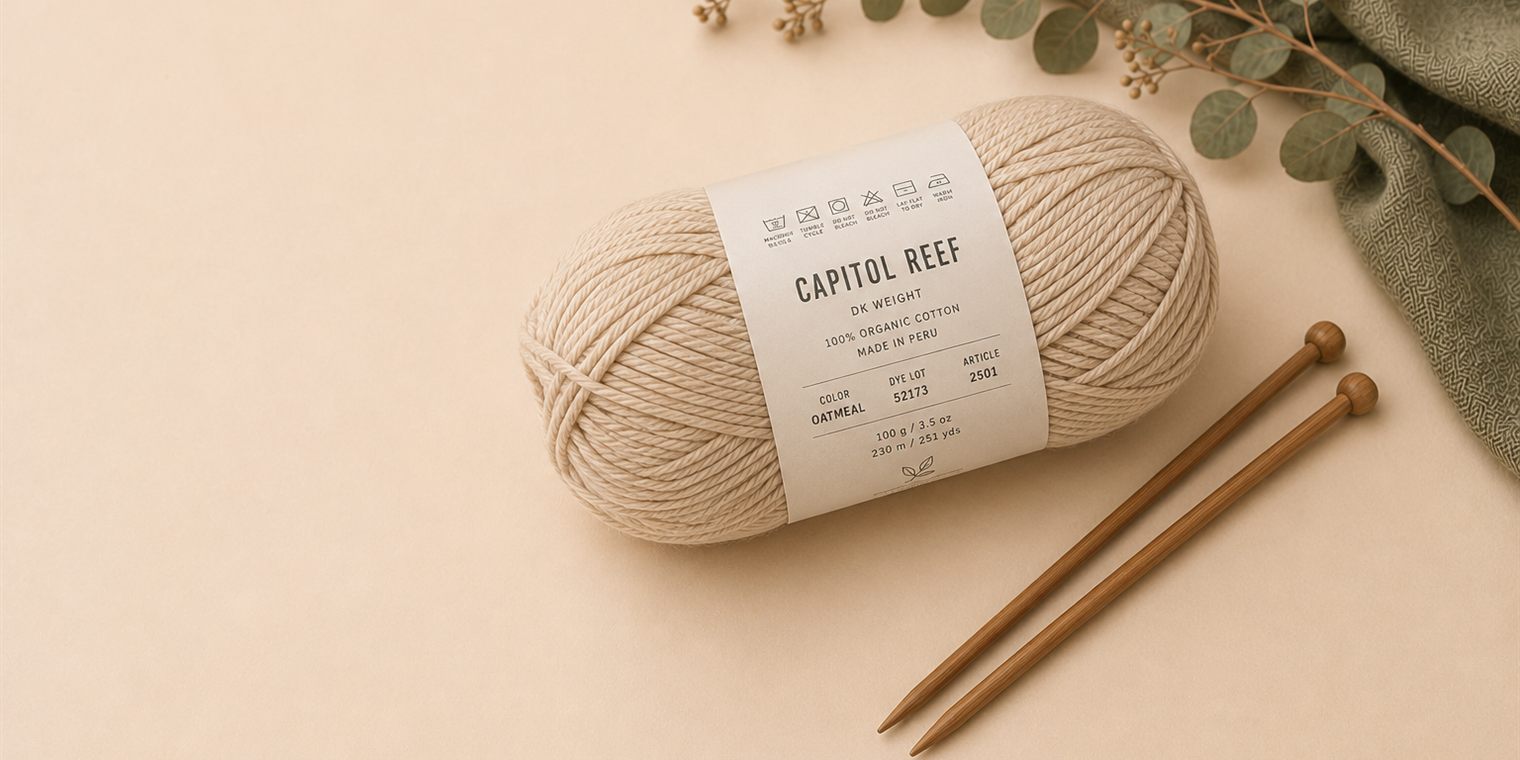
The weight class — lace, fingering, sport, DK, worsted, aran, bulky — describes the yarn's thickness. Some labels use a number system instead, from 0 (lace) to 7 (jumbo); DK is a 3, worsted a 4. This single word does more to determine what you can make than anything else on the band.
The gauge square tells you what fabric the mill expects: something like "22 sts = 4 in / 10 cm on US 6 / 4.0 mm needles." It's a suggestion, not a law — you can knit fingering weight on big needles for an airy shawl — but when a pattern and a label agree on gauge, substitution gets easy.
Yardage and grams matter together. A 100g skein might hold 400+ yards of fingering or barely 60 of jumbo. Patterns state requirements in total yards or meters precisely because skein sizes vary between brands; always compare total yardage, never "number of balls."
Fiber content changes how the fabric behaves and how you wash it. The care icons — the little tub, the triangle, the iron — follow the standard laundry symbol system. "Superwash" wool is machine-washable wool; regular wool will felt into doll clothes in a hot cycle. When in doubt, hand-wash cold and lay flat.
Finally, the dye lot. Skeins dyed in different batches can differ subtly, and the difference that's invisible in the shop becomes a visible stripe across a sweater. Buying enough of one lot — plus a safety skein — is the oldest advice in knitting because it's the most learned-the-hard-way advice in knitting.
When you add a yarn to your stash here, we pull the catalog data — weight, yardage per skein, grams — from Ravelry automatically, so your stash records stay as accurate as the label. Mystery yarn with no band? Add it manually with your best guess; estimates are fine, and matching stays honest about ranges.
The difference that's invisible in the shop becomes a visible stripe across a sweater.
Label fluency makes every other skill easier — substitution, stash tracking, even impulse buying gets smarter. Practice on these popular fingering-weight patterns.