How Much Yarn Do I Need?
The ballpark numbers by project, a kitchen-scale trick that turns "it depends" into an actual figure, and the record-keeping that means you only work it out once.
Techniques · Purl Wise Editorial · Aug 2026 · 9 min read
"How much yarn do I need?" is the most-asked question in knitting, and it gets the most frustrating answer: it depends. But it depends on a short list of things, and once you can name them, you can go from a vague worry to a real number in about ten minutes.
Start with the ballpark. An adult hat in worsted weight runs 150 to 250 yards, and mittens are much the same. A cowl that loops once, 200 to 350. A pair of adult socks in fingering lands between 350 and 450 — which is exactly why sock yarn is sold in 400-yard skeins. A shawl is anywhere from 400 to 900, depending on how long you keep going. An adult sweater in worsted runs 1,000 to 1,800 yards; the same sweater in fingering can reach 2,200, because thinner yarn needs more stitches to cover the same body. A throw blanket starts around 1,200 and climbs from there, cheerfully.
Those ranges are wide for two reasons, and both are worth understanding. The first is size. A garment is a surface, so yardage scales with area, not with your chest measurement. Going from a 36-inch bust to a 48-inch one isn't 33 percent more yarn — it's closer to half again, because the piece grew in both directions at once. The second is gauge. Knit the same yarn tighter and you pack more of it into every square inch; knit it looser and the fabric gets airier and goes further. Two knitters can follow one pattern in one yarn and finish 15 percent apart on yardage, purely on tension.
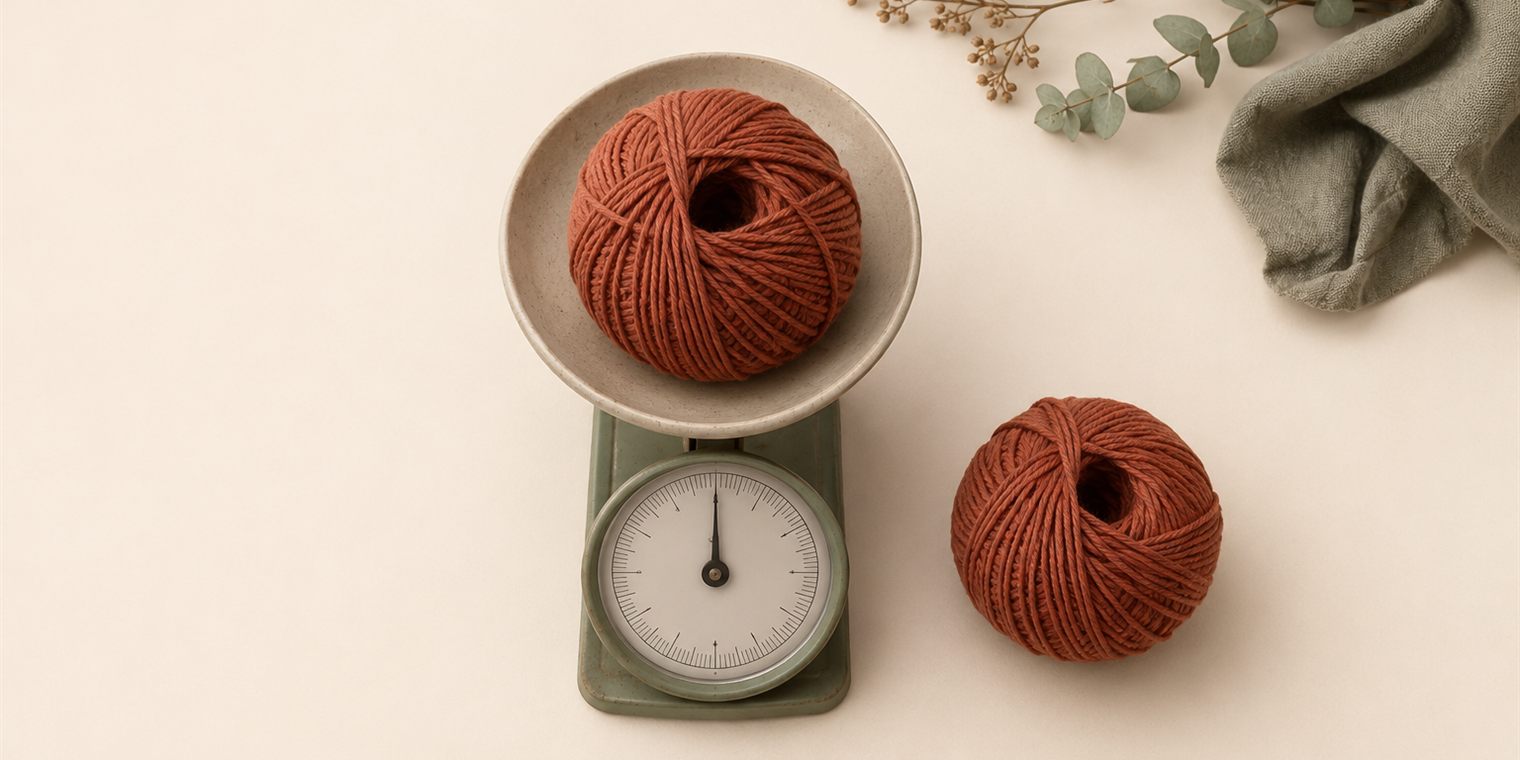
If you want an actual number instead of a range, weigh your swatch. Knit a generous one — six inches square, washed and dried the way you'll treat the finished thing — and put it on a kitchen scale that reads tenths of a gram. Say it comes in at 9 grams across 36 square inches. That's 0.25 grams of yarn per square inch, in your yarn, at your tension.
Now sketch your project as simple shapes. A hat is a tube roughly 21 inches around and 8 inches tall, plus a crown to close it — call the whole thing 200 square inches. Multiply by 0.25 and you need about 50 grams. If your skein is 100 grams and 220 yards, 50 grams is around 110 yards. That's your answer, in your yarn, at your tension — and it took one swatch and a scale.
Better still, weigh a finished garment you already love the fit of: it beats any swatch, because it includes the ribbing, the sleeves and the true dimensions after blocking.
Whichever method you use, add a margin. Ten percent is the usual advice and it holds up for anything with a fixed size; make it twenty for a shawl or a scarf, where the temptation to keep knitting is the whole point. Buy that margin at the same time as the rest, not later. Skeins dyed in different batches can differ by a shade that is completely invisible under shop lighting and completely obvious across a finished back.
The harder version of this question isn't "how much do I need" — it's "do I have enough?" That one has ended more projects than any other, usually at the eleventh hour, three inches from a bind-off, with a discontinued yarn and no way to get more. The fix is unglamorous: know what you actually have left, not what the ball band claimed when the skein was full.
Keep a line per finished project, filed by yarn weight rather than by date — DK, size S pullover, 4 skeins — and within a year you'll have a chart worth more than any generic one.
That's the job My Stash does here, and it doubles as that record. Note what's genuinely remaining — a partial skein weighed on the same kitchen scale beats a guess every time — and the yardage filter on the Patterns page will only show you projects that fit inside it. When you log yarn against a project we ask what it's becoming and keep the yards beside the answer, so the chart builds itself while you knit. Click a single yarn and you get the question asked properly: what can I make with this, at the amount I really have?
The best yardage estimate you will ever get is one you wrote down yourself, last time.
Ballparks get you shopping; a scale and a notebook get you finishing. Here are worsted hats — the project the maths above was worked for.